
Ready to explore aesthetic treatments?
Schedule a free consultation with our medical team in Miami.
If you are researching injectable treatments for facial rejuvenation, you have almost certainly encountered both Botox and dermal fillers. While they are often mentioned together and sometimes confused with one another, these are fundamentally different dermal filler treatments and neuromodulators that address different aspects of facial aging. Understanding how each one works, what it treats, and when to use one versus the other — or both together — is essential for making informed decisions about your aesthetic care.
This guide provides a comprehensive comparison of dermal fillers and Botox, covering their mechanisms, treatment areas, longevity, what to expect during treatment, and how to determine which approach is right for your specific concerns.
Understanding How Aging Changes the Face
Before comparing treatments, it helps to understand what actually happens to the face as we age. Facial aging is not just about wrinkles. It involves multiple simultaneous changes across different tissue layers:
Bone Resorption
The facial skeleton gradually loses volume over time. The eye sockets enlarge, the midface flattens, and the jawline recedes. This skeletal change is one of the primary structural drivers of aging appearance (1).
Fat Pad Descent and Volume Loss
The face contains distinct compartments of fat that provide youthful fullness and contour. With age, these fat pads shrink, descend under gravity, and lose their structural support, contributing to hollow temples, flattened cheeks, deeper nasolabial folds, and jowling.
Collagen and Elastin Degradation
The dermis loses approximately 1 percent of its collagen per year after age 30, along with degradation of elastin fibers. This results in thinner, less resilient skin that is more prone to wrinkling and sagging (2).
Muscle Activity
Decades of repetitive facial expressions — squinting, frowning, raising the eyebrows — create grooves in the overlying skin that eventually become permanent lines (dynamic wrinkles becoming static wrinkles).
Effective facial rejuvenation addresses these different mechanisms, which is why Botox and fillers are complementary rather than interchangeable.
Botox: How It Works and What It Treats
Mechanism of Action
Botox (onabotulinumtoxinA) is a neuromodulator — a purified protein that temporarily blocks the nerve signals that tell muscles to contract. When injected into specific facial muscles, it prevents those muscles from creating the expressions that cause dynamic wrinkles. The muscle relaxes, the overlying skin smooths, and the wrinkle softens or disappears (3).
Other neuromodulators that work similarly include Dysport (abobotulinumtoxinA) and Xeomin (incobotulinumtoxinA). While their mechanisms are essentially the same, they differ slightly in formulation, spread characteristics, and onset time.
What Botox Treats Best
Botox excels at treating dynamic wrinkles — lines that appear or deepen with facial movement:
- Forehead lines — Horizontal lines caused by raising the eyebrows
- Frown lines (glabellar lines or ”11s”) — Vertical lines between the brows caused by frowning or concentrating
- Crow’s feet — Fan-shaped lines at the outer corners of the eyes caused by squinting and smiling
- Bunny lines — Lines on the sides of the nose
- Lip lines — Fine vertical lines above the upper lip
- Chin dimpling — Pebbled or “orange peel” texture on the chin
- Gummy smile — Excessive gum exposure when smiling
- Masseter hypertrophy — Enlargement of the jaw muscles for jawline slimming
- Platysmal bands — Vertical bands on the neck
What Botox Cannot Do
Botox does not:
- Add volume to the face
- Fill in deep lines or folds that are present at rest
- Lift sagging skin or restore lost contour
- Treat hollowness under the eyes or in the cheeks
- Enhance the lips or chin
These are the domains of dermal fillers.
Dermal Fillers: How They Work and What They Treat
Mechanism of Action
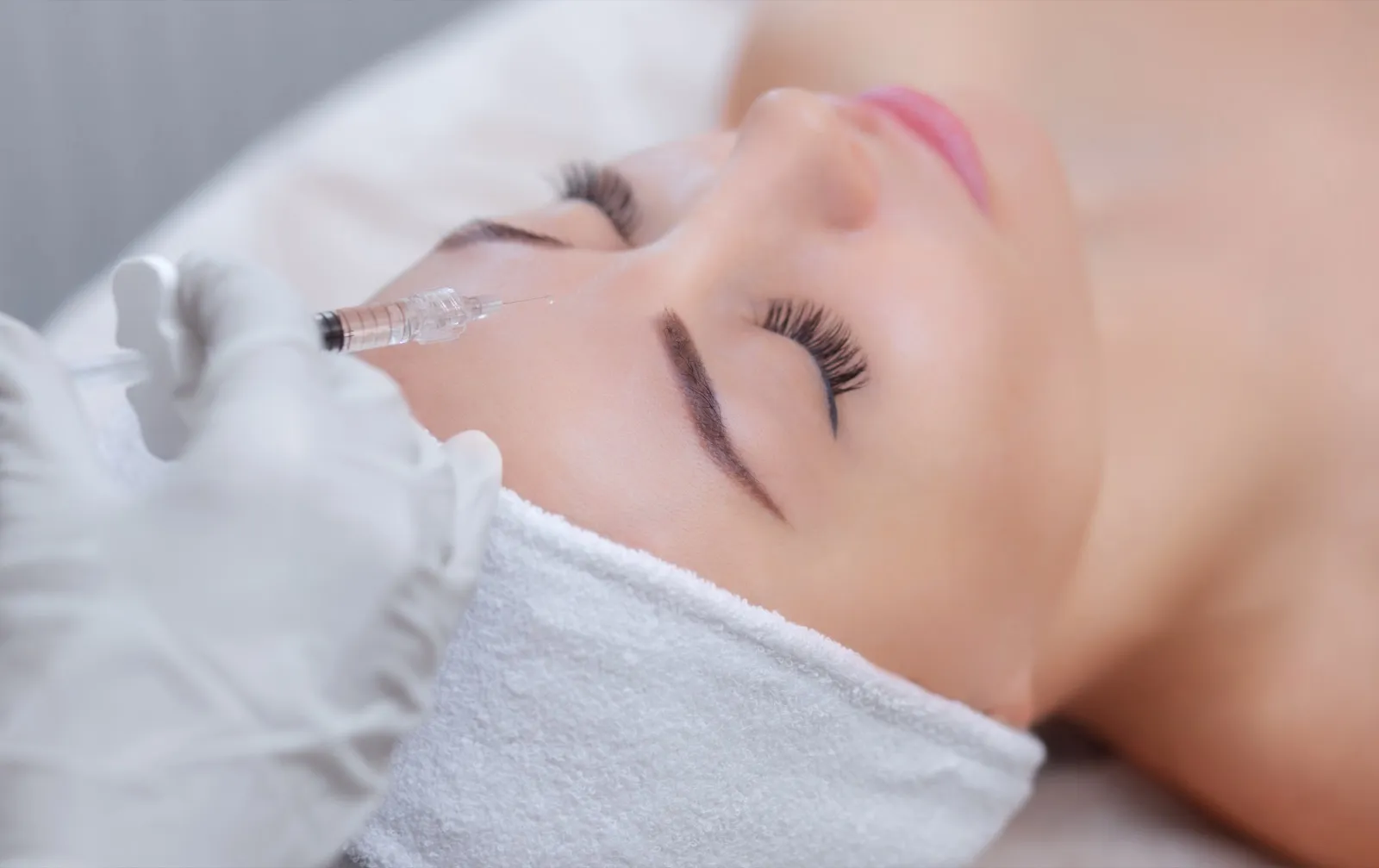
Dermal fillers are gel-like substances injected beneath the skin’s surface to restore volume, smooth lines, enhance contours, and improve facial proportions. Unlike Botox, which works on muscles, fillers work in the tissue itself — adding structure and volume where it has been lost.
The most commonly used fillers are based on hyaluronic acid (HA), a naturally occurring substance in the skin that attracts and retains moisture. Popular HA filler brands include Juvederm, Restylane, RHA Collection, and Revanesse Versa+ (commonly called Versa). Each brand offers multiple products with different consistencies designed for specific areas and depths.
Other types of dermal fillers include:
- Calcium hydroxylapatite (Radiesse) — A thicker filler that also stimulates collagen production, often used for cheeks, jawline, and hands
- Poly-L-lactic acid (Sculptra) — A biostimulatory filler that gradually stimulates the body’s own collagen production over several months
- Polymethylmethacrylate (Bellafill) — A semi-permanent filler containing microspheres suspended in collagen
What Fillers Treat Best
Dermal fillers excel at addressing volume loss, structural deficiency, and static wrinkles:
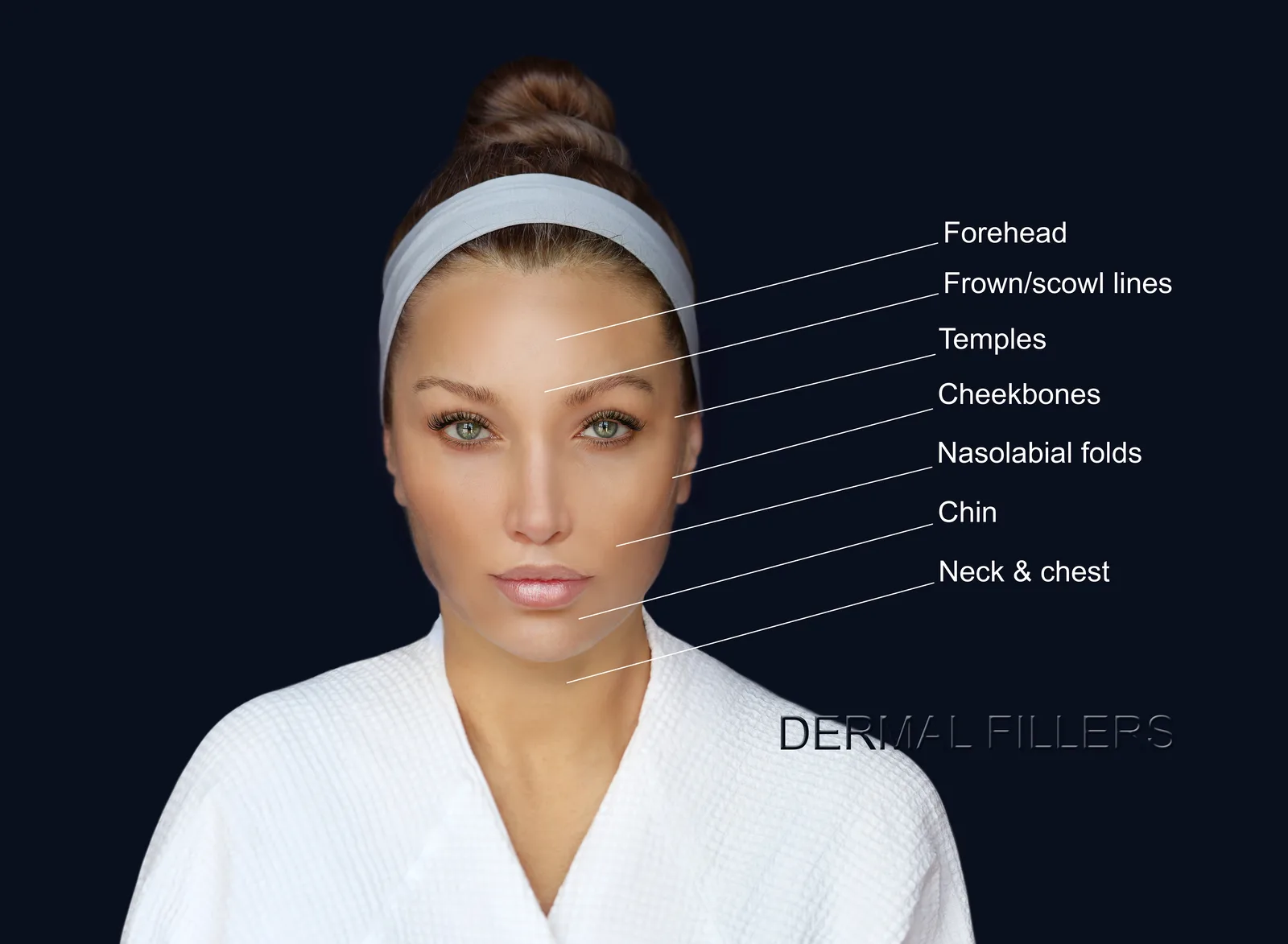
- Cheeks and midface — Restoring youthful fullness and lifting the midface
- Nasolabial folds (smile lines) — The lines running from the nose to the corners of the mouth
- Marionette lines — Lines running from the corners of the mouth to the chin
- Under-eye hollows (tear troughs) — Dark circles and hollowness beneath the eyes
- Lips — Volume enhancement, border definition, and smoothing vertical lip lines (see our lip filler services)
- Chin — Projection, definition, and lengthening
- Jawline — Contouring, definition, and reducing the appearance of jowls
- Temples — Restoring volume to hollow, sunken temples
- Hands — Reducing the visibility of tendons and veins on aging hands
- Nose (non-surgical rhinoplasty) — Smoothing bumps, lifting the tip, or improving symmetry
What Fillers Cannot Do
Fillers do not:
- Relax muscles or stop them from creating wrinkles
- Effectively treat dynamic wrinkles in the upper face (forehead lines, crow’s feet, frown lines)
- Replace the need for surgical intervention when skin laxity is severe
- Stop the aging process (though biostimulatory fillers like Sculptra can support collagen production)
Dermal Fillers vs. Botox: A Side-by-Side Comparison
| Feature | Botox | Dermal Fillers |
|---|---|---|
| What it is | Neuromodulator (purified protein) | Injectable gel (HA, CaHA, PLLA) |
| How it works | Relaxes muscles | Adds volume and structure |
| Treats | Dynamic wrinkles (movement-based) | Volume loss, static wrinkles, contour |
| Primary areas | Forehead, frown lines, crow’s feet | Cheeks, lips, jawline, nasolabial folds |
| Onset | 3-5 days (full effect at 14 days) | Immediate (with minor swelling) |
| Duration | 3-4 months | 6-24 months (product-dependent) |
| Reversible | Yes (wears off naturally) | HA fillers: yes (hyaluronidase); others: no |
| Downtime | Minimal (possible mild bruising) | Minimal (possible swelling, bruising for 3-7 days) |
| Pain level | Mild (brief pinch) | Mild to moderate (lidocaine in most fillers) |
| Number of sessions | 1 per treatment cycle | Often 1, some plans staged over 2-3 visits |
Treatment Areas: Which Do You Need?
Upper Face — Primarily Botox Territory
The upper third of the face is dominated by dynamic muscles responsible for expression. Forehead lines, frown lines, and crow’s feet are best treated with Botox treatments at our Miami clinic or Dysport. While fillers can occasionally be used in the forehead to address very deep static lines, this is uncommon and requires considerable expertise.
Exception: The temples are an upper face area treated with fillers. Temple hollowing is a common sign of aging that creates a skeletal appearance, and filler provides excellent restoration of this volume.
Midface — Primarily Filler Territory
The cheek area is almost exclusively addressed with dermal fillers. Age-related volume loss in the malar (cheek) fat pads leads to a flattened, tired appearance. Restoring cheek volume with filler not only enhances the cheeks themselves but also provides a lifting effect that softens nasolabial folds and reduces the appearance of under-eye hollows.
Lower Face — Combination Territory
The lower face often benefits from both treatments:
- Lip lines — Botox can soften the muscles that pucker the lips, while filler can smooth the lines themselves
- Marionette lines — Fillers address these directly
- Jawline — Fillers provide contour and definition, while Botox can slim the masseter muscles for a narrower, more refined jawline
- Chin — Fillers improve projection and shape; Botox addresses chin dimpling
Neck — Botox With Possible Filler
Platysmal bands on the neck respond well to Botox. Some practitioners also use filler or biostimulatory agents in the neck for skin quality improvement, though this is a more advanced technique.
Combining Botox and Fillers: The Liquid Facelift
One of the most powerful approaches to non-surgical facial rejuvenation is combining Botox and fillers in a single treatment session or coordinated treatment plan. This is sometimes called a “liquid facelift” because it addresses multiple dimensions of aging simultaneously.
Why Combination Works So Well
Think of it this way: Botox addresses the wrinkles caused by muscle movement in the upper face, while fillers restore the volume and structure lost in the mid and lower face. Together, they produce a comprehensive rejuvenation that looks natural because both components of aging — dynamic wrinkles and volume loss — are being addressed.
A Typical Combination Treatment Might Include
- Botox to the forehead, frown lines, and crow’s feet (upper face)
- Filler to the cheeks for midface volume restoration
- Filler to the nasolabial folds and marionette lines
- Botox to the masseter for jawline slimming
- Filler to the chin for improved proportion
Staged Approach
Some patients prefer a staged approach, addressing one area at a time over several visits rather than doing everything at once. This can be easier to manage in terms of cost, recovery, and adjusting to changes. It also allows you and your provider to evaluate each treatment’s effect before adding more.
What to Expect During Treatment
Botox Treatment Experience
- Duration: 10 to 15 minutes
- Pain: Minimal — brief pinch with each injection; most patients do not require numbing
- Needles: Very fine (30-32 gauge)
- Number of injections: Typically 5 to 20 small injections depending on areas treated
- Immediate after: You can return to normal activities immediately. Minor redness at injection sites resolves within minutes to hours.
- Restrictions: Avoid lying down for 4 hours, no strenuous exercise for 24 hours, no rubbing the treated areas
Dermal Filler Treatment Experience
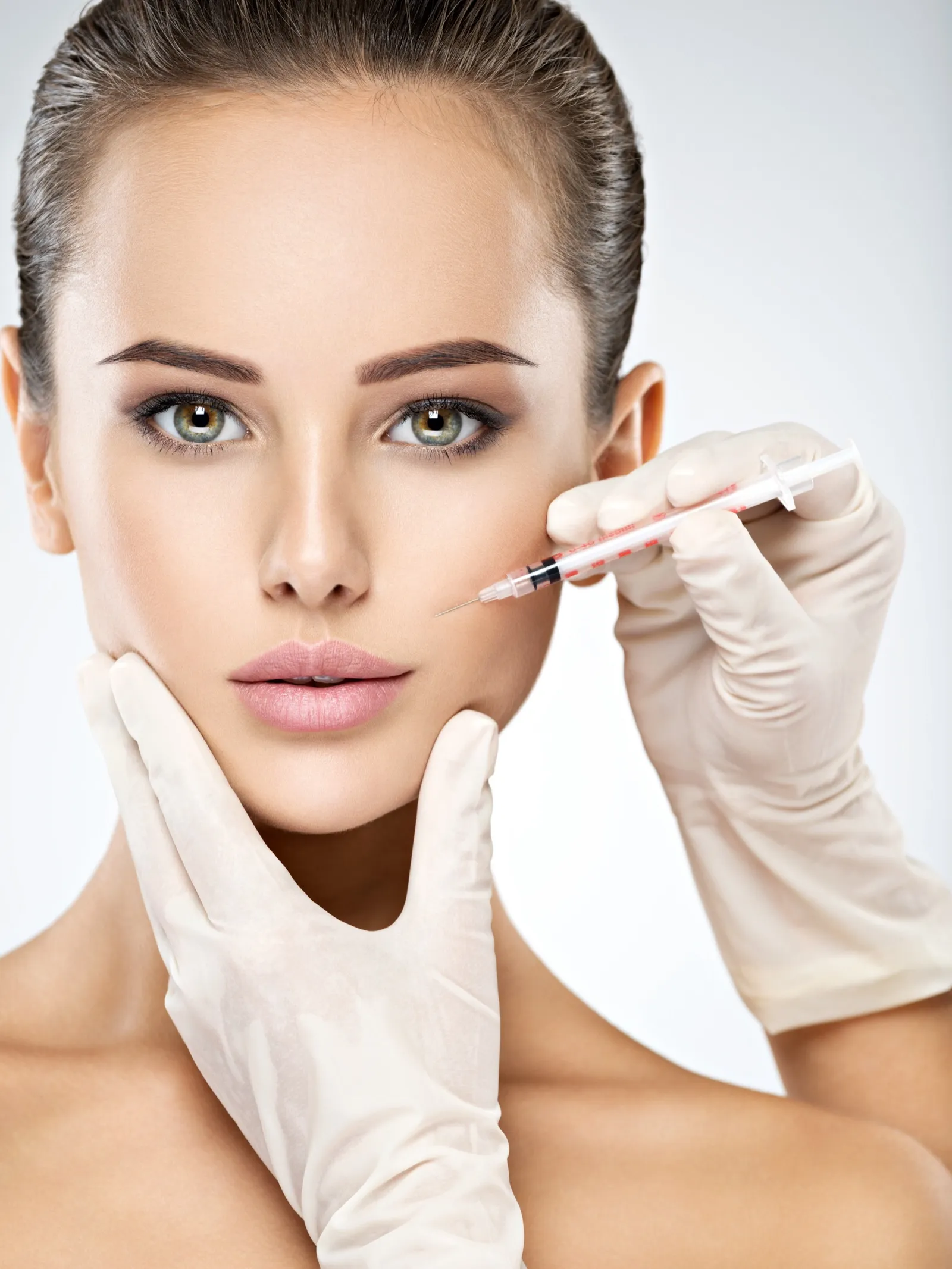
- Duration: 15 to 45 minutes depending on areas treated
- Pain: Mild to moderate — most fillers contain lidocaine (a numbing agent); additional topical numbing can be applied beforehand
- Needles/cannulas: May use standard needles or blunt-tip cannulas depending on the area and provider technique; cannulas often reduce bruising
- Volume: Typically 1 to 4 syringes per session depending on the treatment plan
- Immediate after: Results are visible immediately, though some swelling is normal. You can return to most activities the same day.
- Restrictions: Avoid strenuous exercise for 24 to 48 hours, minimize alcohol, avoid excessive heat, do not press or massage the treated areas unless instructed
Recovery Comparison
Both treatments involve minimal downtime compared to surgical alternatives. Botox typically has slightly less post-treatment visible effects (minimal to no swelling), while fillers may produce noticeable swelling and bruising for 3 to 7 days, particularly in thinner-skinned areas like the lips and under-eyes.
Pricing Considerations
Botox Pricing Considerations
Botox is priced per unit. The number of units required depends on the muscle being treated, your individual muscle strength, the depth of existing lines, and your aesthetic goals. Typical session size — units per area, not dollars — looks like:
- Forehead: 15 to 25 units
- Frown lines: 20 to 30 units
- Crow’s feet: 16 to 24 units (both sides)
Because Botox requires retreatment every 3 to 4 months to maintain results, annualized cost depends on which areas you treat and how often. We discuss specific pricing for your treatment plan transparently at consultation.
Filler Pricing Considerations
Dermal fillers are priced per syringe. The number of syringes a treatment plan calls for depends on which areas you address, the products selected, and how much volume change you are seeking. A typical plan might involve:
- Cheeks: 1 to 2 syringes
- Nasolabial folds: 1 to 2 syringes
- Lips: 1 syringe
- Jawline/chin: 1 to 3 syringes
Because most fillers last 6 to 18 months, annualized cost may be comparable to or less than maintaining Botox despite the higher per-session investment. As with Botox, specific pricing is reviewed at consultation based on your individualized plan.
Value of Combination
While a comprehensive treatment plan involving both Botox and fillers represents a greater initial investment, many patients find the combined result significantly more impactful than either treatment alone. At Rewind, we work with each patient to develop a phased treatment plan that aligns with their goals and budget.
Which Is Right for You?
Choose Botox If:
- Your primary concern is lines that appear when you make facial expressions
- You want to prevent wrinkles from becoming deeper or permanent
- You are in your twenties or thirties and interested in preventive treatment
- You have crow’s feet, forehead lines, or frown lines you want to soften
- You want to slim your jawline (masseter Botox)
- You prefer a quick treatment with essentially no downtime
Choose Dermal Fillers If:
- Your primary concern is loss of facial volume or fullness
- You have deep lines or folds visible even when your face is at rest
- You want to enhance your lips, cheeks, chin, or jawline
- You have hollow under-eyes or sunken temples
- You want longer-lasting results per treatment session
- You are looking for facial contouring and proportion improvement
Choose Both If:
- You are over 35 and experiencing both wrinkles and volume loss (most patients)
- You want the most comprehensive non-surgical rejuvenation possible
- You want natural-looking results that address aging from multiple angles
- You are looking for an alternative to surgical facelift or want to extend the results of previous surgery
The Rewind Approach to Injectable Aesthetics
At Rewind Anti-Aging Miami, we believe that exceptional aesthetic results come from understanding the whole face — not just treating individual wrinkles in isolation. Our approach involves:
- Comprehensive facial assessment — Analyzing bone structure, fat distribution, skin quality, muscle activity, and proportions
- Personalized treatment plan — Recommending the right combination of Botox, Dysport, and dermal fillers for your unique anatomy and goals
- Conservative, natural results — Our philosophy is enhancement, not transformation. We aim for results that make you look refreshed, rested, and like the best version of yourself
- Staged planning — For patients who want comprehensive rejuvenation, we often recommend a phased approach to manage investment and allow progressive refinement
- Ongoing optimization — As your face continues to change over time, we adjust your treatment plan to maintain consistently excellent results
Schedule a consultation at Rewind to discuss your aesthetic goals and learn which combination of treatments will help you achieve the natural, youthful appearance you are looking for.
Related Articles
- How Long Does Botox Last? Duration, Factors, and Tips
- Lip Filler: What to Expect Before, During, and After
- Botox vs Dysport: Which Neuromodulator Is Right for You?
Interested in aesthetic treatments? Rewind Anti-Aging of Miami offers personalized dermal filler treatments and Botox treatments with comprehensive support and monitoring. Schedule a consultation →
FDA Disclaimer: Botox (onabotulinumtoxinA) and Dysport (abobotulinumtoxinA) are FDA-approved neuromodulators for the temporary improvement of facial wrinkles. Juvederm, Restylane, and other hyaluronic acid fillers are FDA-approved dermal fillers for various facial indications. All injectable treatments carry potential risks and should be administered by qualified, trained medical professionals. Individual results vary.
References
- Mendelson B, Wong CH. Changes in the facial skeleton with aging: implications and clinical applications in facial rejuvenation. Aesthetic Plast Surg. 2012;36(4):753-760.
- Varani J, Dame MK, Rittie L, et al. Decreased collagen production in chronologically aged skin: roles of age-dependent alteration in fibroblast function and defective mechanical stimulation. Am J Pathol. 2006;168(6):1861-1868.
- Pirazzini M, Rossetto O, Eleopra R, et al. Botulinum neurotoxins: biology, pharmacology, and toxicology. Pharmacol Rev. 2017;69(2):200-235.
FDA Prescribing Information for Products Discussed
- BOTOX Cosmetic (onabotulinumtoxinA) prescribing information. Allergan (AbbVie). accessdata.fda.gov label/2021/103000s5320lbl.pdf.
- Dysport (abobotulinumtoxinA) prescribing information. Galderma/Ipsen. accessdata.fda.gov label/2023/125274s125lbl.pdf.
- Xeomin (incobotulinumtoxinA) prescribing information. Merz. accessdata.fda.gov label/2024/125360s099lbl.pdf.
- JUVÉDERM Ultra XC directions for use. Allergan. PMA P050047. accessdata.fda.gov cdrh_docs/pdf5/P050047S044d.pdf.
- JUVÉDERM Volbella XC directions for use. Allergan. PMA P110033/S053. accessdata.fda.gov cdrh_docs/pdf11/P110033S053C.pdf.
- Restylane / Restylane-L instructions for use. Galderma. PMA P040024. accessdata.fda.gov cdrh_docs/pdf4/P040024S056c.pdf.
- RHA Collection (RHA 2/3/4) FDA approval. Revance/Teoxane. PMA P170002. fda.gov/medical-devices/recently-approved-devices/rha-3-dermal-filler-p170002s030.
- Revanesse Versa+ FDA Summary of Safety and Effectiveness Data. Prollenium. PMA P160042. accessdata.fda.gov cdrh_docs/pdf16/P160042S010B.pdf.
- RADIESSE injectable implant instructions for use. Merz. PMA P050037. accessdata.fda.gov cdrh_docs/pdf5/p050037c.pdf.
- Sculptra Aesthetic instructions for use. Galderma. PMA P030050. accessdata.fda.gov cdrh_docs/pdf3/P030050S039C.pdf.
- Bellafill patient labeling. Suneva Medical. PMA P020012/S009. accessdata.fda.gov cdrh_docs/pdf2/P020012S009c.pdf.
Frequently Asked Questions
What is the main difference between dermal fillers and Botox?
The fundamental difference is in how they work. Botox is a neuromodulator that temporarily relaxes facial muscles to smooth dynamic wrinkles caused by movement, such as forehead lines, frown lines, and crow's feet. Dermal fillers are gel-like substances injected beneath the skin to restore lost volume, fill in static lines, and enhance facial contours. Botox addresses muscle-driven wrinkles while fillers address volume loss and structural changes.
Can you get Botox and fillers at the same time?
Yes, Botox and fillers are frequently used together in the same treatment session, an approach sometimes called a liquid facelift. This combination addresses both dynamic wrinkles (with Botox) and volume loss (with fillers) for comprehensive facial rejuvenation. Many patients find that combining the two produces more natural and complete results than either treatment alone.
Which lasts longer, Botox or fillers?
Dermal fillers generally last longer than Botox. Botox typically lasts 3 to 4 months before requiring retreatment. Hyaluronic acid fillers such as Juvederm and Restylane last 6 to 18 months depending on the specific product and treatment area. Some fillers like Sculptra (poly-L-lactic acid) or Radiesse (calcium hydroxylapatite) can produce results lasting 1 to 2 years or more.
Is Botox or filler better for wrinkles?
It depends on the type of wrinkle. Dynamic wrinkles that appear with facial expressions, like forehead lines, frown lines, and crow's feet, are best treated with Botox. Static wrinkles that are visible even at rest, such as nasolabial folds, marionette lines, and deep cheek creases, are better addressed with dermal fillers. Many patients have both types and benefit from a combination approach.
Which is more expensive, Botox or fillers?
Per session, Botox typically costs less than dermal fillers because Botox is priced per unit while fillers are priced per syringe. However, because Botox needs to be repeated every 3 to 4 months while many fillers last 6 to 18 months, the annualized cost may be comparable depending on your treatment plan and product selection. Specific pricing for both treatments is reviewed transparently at consultation, where we tailor the plan to your goals and anatomy.
Are dermal fillers safe?
Yes, FDA-approved dermal fillers have an excellent safety profile when administered by a qualified, experienced injector. Hyaluronic acid fillers carry the additional safety advantage of being reversible with an enzyme called hyaluronidase. Common temporary side effects include bruising, swelling, and redness at the injection site, which typically resolve within a few days. Serious complications are rare when treatment is performed by a trained medical professional.
What areas can fillers treat that Botox cannot?
Dermal fillers excel in areas where volume restoration or enhancement is the goal, including the cheeks and midface, under-eye hollows (tear troughs), nasolabial folds, marionette lines, lips, chin, jawline, temples, and hands. Botox cannot add volume or structure to these areas. Conversely, Botox treats muscle-driven wrinkles in the upper face that fillers cannot effectively address.
How do I know if I need Botox, fillers, or both?
The best way to determine the right treatment is a consultation with an experienced aesthetic provider. As a general guide: if your primary concern is lines that appear when you make expressions, Botox is likely the answer. If your concern is hollowness, flatness, deep folds, or loss of facial contour, fillers are more appropriate. If you have both issues, which most patients over 35 do, a combination approach typically produces the most natural and comprehensive results.
More in aesthetics
GLP-1 Weight Loss and "Ozempic Face": Managing the Aesthetic Side
"Ozempic face" is the aesthetic cost of rapid GLP-1 weight loss — why facial volume drops faster than body fat, and how to slow it with protein, training, and treatments.
aestheticsHow Testosterone (and Estrogen) Affect Skin Aging
Skin aging is hormone-driven before it is sun-driven: testosterone, estrogen, and growth hormone shape collagen and thickness — why skincare hits a ceiling.
aestheticsHow Long Does Botox Last? Duration, Factors, and Tips
Find out how long Botox lasts, what factors affect its duration, first-time vs repeat treatments, Botox vs Dysport longevity, and tips to extend your results.
⚕ Medical Disclaimer
The information on this page is for educational purposes only and does not constitute medical advice, diagnosis, or treatment. All treatments at Rewind Anti-Aging of Miami are performed under the supervision of licensed medical professionals. Individual results may vary. Consult your physician before beginning any new treatment protocol.
Meet our clinical team →Not sure which treatment is right for you?
Take our free 2-minute assessment and get a personalized recommendation.
Areas We Serve in Miami & South Florida
Our clinic at 24 NW 29th Street is in Wynwood & Midtown, minutes from Edgewater and Brickell. We also care for patients across Coral Gables, Aventura, Key Biscayne, and Doral — plus the entire state of Florida via telehealth.
Take the Next Step
Our team at Rewind Anti-Aging in Miami is here to help you determine if aesthetic treatments is right for your goals.